Mao Zedong dispersed China's industry in the 1950s so that his young Communist regime would be less vulnerable to attack. The loss of any one part of China would not then prove economically disastrous, he reasoned. He would be able to retreat to any part of the country, if necessary, and still have the means to supply his army.
This move left China with a lopsided economy, especially its state-owned sector, and has added a unique regional dimension to the restructuring that would anyway be occurring to state-run industries going through the sort of changes that China has been experiencing since Deng Xiaoping set off down the path of economic reform in the late 1970s.
Though it might cause Mao to turn in his grave, private enterprise now accounts for the majority of economic output in China. It is more efficient and faster-growing than the state sector. It is not constrained by being an anchor industrial employer in places where it often has no natural advantages.
Private companies in China remain small--agriculture, wholesale and retail distribution and construction are dominated by thousands of small family firms--and they face considerable barriers to growth; access to markets and capital still depends greatly on connections. They are, though, on the whole profitable.
The state sector, composed of about 150,000 state-owned enterprises, is a different story. These firms are often big and unprofitable. An study by the Organization for Economic Cooperation and Development (OECD) based on data from 2003 found that they wrung half the productivity from twice the capital.
State enterprise assets represent about 85% of China's gross domestic product, about three times higher than in even the most state-dominated Western European economies, France and Italy, and well above the rate typical in economies making the transition from developing to developed.
Not all are hopeless basket cases. Productivity and profitability are improving surely, if slowly. The return on equity at state industrial firms rose from 3.4% in 1998 to 10.2% in 2003, according to the OECD study. That is short of the private sector's 14.4%, but still passable.
However, the best performance is concentrated in the largest 20% or so of state enterprises. They tend to be the ones that Beijing is using to drive development across the economy in the industries that are the boiler rooms of growth: energy ( PetroChina), banking ( Bank of China), utilities ( Huaneng Power), chemicals ( Sinopec), heavy industry ( Baoshan Iron & Steel), telecommunications ( China Telecom) and transport ( Air China).
Beijing's industrial policy for its state-owned enterprises is two-pronged: to develop national champions that can compete in world markets, and to ease the strain the basket cases impose on the national treasury.
Except at the top end (the companies that make our list of China's largest companies), even China's biggest companies are not so sizable by world standards. Only 14 make the list of the world's 500 largest companies by sales, of which eight are state-owned.
Hence, a policy emphasis on achieving economies of scale and scope. Since the late 1980s, informal links between large enterprises have been formalized through merger and consolidation. That has distilled 120 industrial groups identified as national A-list companies, with a further 2,300 similarly preferred companies at provincial and city levels.
The national champions have been given more decision-making and financial autonomy and priority in the allocation of state-controlled resources, including investment and capital.
They have been encouraged to create research centers (even China's biggest companies devote only 1% of sales to research and development, on average--compared to 5% in the West) and develop their foreign trade. They have also been earmarked for stock-market listings.
They were initially given protective tariff support, although that is being removed in line with China's World Trade Organization entry obligations.
Beijing is also trying to pull off a delicate balancing act: imposing the disciplines of the market on management while keeping policy control of its national and local champions firmly in trusted hands. This has led to the creation of a hybrid group structure, not dissimilar to the industrial groupings that underpinned Japan Inc.
Under this model, a holding company, run by politically appointed managers, controls a network of associated operating companies via controlling or minority shareholdings. One or more of the associated companies may be selected as the vehicle for a public listing on a stock exchange; others of the associated companies may be designated to absorb a large amount of the group's underperforming assets.
A side benefit of this structure is that it has created national industrial networks that circumvent the local protectionism and vested interests that are a legacy of Mao's industrial policy. That, in turn, has eased Beijing's way toward meeting its WTO market-opening obligations.
Since 2003, supervision of the very largest state-owned companies in China has fallen to the State-owned Assets Supervision and Administration Commission (SASAC), a high-level commission whose writ runs to about 180 companies. It has set an internal target of having 50 Chinese companies, including state-owned ones, among the largest 500 companies by sales in the world by 2015.
To this end, it recently linked the salaries and bonuses of the presidents of 30 of the biggest state-owned enterprises, including China National Offshore Oil (nyse: CEO - news - people ), to the profitability of their companies.
More M&A can be expected in the state sector as China seeks to create more big companies that can compete internationally. Yet perversely, Beijing will try to do this while tightening its hold on the sector rather than loosening it.
Saturday, September 02, 2006


China Surpasses U.S. In Internet Use
Chinese Internet users spend nearly two billion hours online each week, while the U.S. audience logs on for 129 million hours per week.
Source: China Internet Network Information Center, CNNIC.net
That's the bombshell Dr. Charles Zhang, chairman and CEO of Sohu.com (nasdaq: SOHU - news - people ), dropped last month after ringing the opening bell at the Nasdaq, a milestone for a Beijing-based company.
Zhang reported that, according to his internal research, Chinese Internet users numbered over 150 million--and possibly up to 200 million--and Sohu.com, including all of their properties, was in the top five most trafficked sites in the world. Nielsen NetRatings, which doesn't have statistics for China, reports that the U.S. had 154 million active users in January 2006. This means that China, if Zhang is correct, is at or above the U.S. in the number of Internet users and that these users stay connected far longer each time.
How could the milestone of China surpassing the U.S. in Internet users have gone so unremarked? It turns out that it isn't that easy collecting data on over a billion people in a country as vast as China, where most people are not connected by phone lines.
The China Internet Network Information Center (CNNIC) reports that the number of active Chinese Internet users was 111 million by Dec. 31, 2005, up from 94 million a year earlier. And over the past two years, it has been growing at a steady rate of 18%. However, according to Zhang, the CNNIC polling is conducted by calling fixed line phones. "Young people do not use fixed line phones. They all have mobile phones," Zhang said, explaining why he believes the CNNIC is reporting lower-than-accurate numbers.
Even if we assume that China is still behind the U.S. in terms of users, China definitely wins in another critical area. One of the most valued metrics of Internet usage (especially for advertisers) is time spent online. Chinese users average 15.9 hours per week, while Yahoo! (nasdaq: YHOO - news - people ), the most popular Internet site in the U.S., can only get its users to stick around for less than one hour per week (216.5 minutes per month according to ComScore Media Metrix). That's 1.765 billion hours per week online in China, compared with 129 million hours per week online in the U.S.
What's up with all that time online? This is the first time in Chinese history that the nation has been connected. As Zhang explains, "People log onto the Internet and Sohu.com because, in China, there is no Forbes, Reuters or The Washington Post. Print media was all state-controlled and official, and the Internet filled this void." Indeed, according to the CNNIC, 67.9% of online use in China is spent devouring news, more than searching (65.7%) and e-mailing (64.7%). By contrast, only 3% of Yahoo!'s U.S. traffic clicks over to news.*
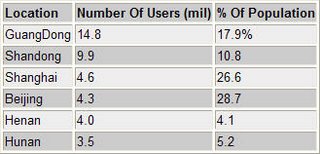
Moreover, China has a lot more room to grow than the U.S. While roughly half of the U.S. population is actively using the Internet, just 11.7% of the Chinese population is currently plugged in.
Internet Users In China

Source: China Internet Network Information Center, CNNIC.net
There are 400 million cell phone users in China, with over 6.1 million mobile users connecting online.** As cell phones increasingly become the connection of choice, you can expect China, which is a generation ahead of the U.S. in mobile technology, to lead the world in mobile Internet-access growth. And everything will hit hyperdrive over the next two years, as the country ramps up to host the summer Olympics, which are being held in Beijing in 2008.
So why is Sohu.com the hottest site on the Web these days, when Baidu.com (nasdaq: BIDU - news - people ) is the better known brand in the U.S.? Sohu.com is up 40% this year, while Baidu.com, the blazing IPO of last summer, has lost 9% since January and is down 63% from its 52-week high.
While Sohu.com, Sina.com and Baidu.com are all in the top ten of most popular global Internet site--above Amazon.com (nasdaq: AMZN - news - people ) and AOL--Sohu.com has twice the revenue and three times the net profit of Baidu.com. And Sohu.com is the official Web site for the 2008 Beijing Olympics. Additionally, Sohu.com was the first publicly traded Chinese company, alongside Sina.com, to adopt Sarbanes-Oxley accounting standards, which speaks well of the management team of Zhang and CFO Carol Yu.
Sohu.com
Charles Zhang is not afraid of heights. Recently, Zhang, 39, the founder of Chinese Internet portal Sohu.com was clinging to the face of Mount Everest, 6,666 m above sea level. That's high but nothing compared with the altitude of his company's stock price. On July 10, Sohu shares closed at $38.25 on NASDAQ--a gain of 245% since April 1. More impressive, Sohu shares are worth 36 times their value during the dark days of the Internet bust, when they traded for less than $1.
Sohu, which started in 1996 as the first Chinese-language search engine, surprised critics by turning profitable in the third quarter of last year. For the second quarter of 2003, it posted a stunning $7.5 million profit on $19.3 million in revenue. But the climb has not always been smooth. During the shake-out following the dotcom crash, shareholders questioned the company's heavy dependence on banner-ad revenue. Hostile board members and disgruntled investors wanted professional management to replace him. Zhang says his nonconfrontational style helped him hold on, but the experience "was the worst sort of psychological torture." Short-messaging service, which helped the company turn around and generated total revenues of $750 million in China last year, now accounts for 48% of Sohu's revenues.
Zhang, who holds a Ph.D. in physics from M.I.T., sees parallels between his recent attempt to scale Everest and his near death business experience: "The temperature was subzero, with winds threatening to blow my tent over, and I was constantly out of breath. But as bad as it was, I'd sooner do it all again than repeat what I went through after the bubble burst." Is he out to climb more mountains? Undoubtedly; he's not afraid of heights. --By Kaiser Kuo/Chengdu
China's Web Watchers

Nothing in Zheng Yichun's upbringing foreshadowed his landing in a political prison. His English-speaking father interrogated captured American G.I.s during the Korean War, and as a teenager two decades later, Zheng led his middle school's Communist Youth League. Only when the reform era hit China in the 1980s did the aspiring poet have what his family calls an "awakening." China's leaders were corrupt and tyrannical, he said, and he would fight them with words. Yet despite the provocative title of his self-published 2002 collection of poems, The Era of Brainwashing, his work went mostly unnoticed. If not for the Internet, Zheng, now 57, might still sit in his mildewed sixth-floor walk-up near the Manchurian city of Dalian, surrounded by bookshelves of Russian literature, tapping verse onto his Legend computer.
But Zheng also shared his thoughts on overseas Chinese-language websites. China's one-party system is "the root of all evil," he wrote in an essay that was one of 63 signed articles he posted on dajiyuan.com, a website popular among Chinese intellectuals. Even though Web surfers in China can't normally access dajiyuan.com;it's among a long list of sites blacklisted by government censors;police arrested Zheng last December on charges of inciting subversion. On Sept. 22, he was sentenced to seven years in prison. Beijing had once again sent a stern message to Chinese who dared to use the Internet to express their political opinions. "Zheng's arrest served as a warning to people like me," said Yang Chunguang, another Dalian-based writer critical of Beijing, shortly before Zheng's sentencing. "I e-mailed dajiyuan.com asking it to take down the things I had posted."
A decade ago, the Internet was hailed as a breakthrough technology for promoting freedom and democracy because its pervasive reach would make it impossible for repressive regimes to control free speech and the flow of information within their borders. The Chinese government has proven this to be wishful thinking. Employing much of the same information-screening and filtering technology used worldwide to combat pornography and spammers, Beijing has built a Great Firewall of China that restricts viewing of scores of foreign websites (such as those for Amnesty International and numerous news sites); the government has also deployed tens of thousands of Internet police to investigate online crimes, including political offenses. While some tech-savvy surfers can find ways through the firewall and past Web police monitors, the vast majority of China's 100-million online population will search in vain for Mandarin equivalents of the Drudge Report, blog screeds and independent journalism that define free online speech in most of the world. A recent study by Harvard Law School's Berkman Center for Internet & Society concluded that "China's Internet filtering regime is the most sophisticated effort of its kind in the world."
But as Zheng's arrest shows, China's taming of the Internet depends more on old-fashioned muscle than on new technology. Above all, Beijing maintains control by instilling the fear in Web scribes and online businesses that they are being watched—and that, if they cross the line, they are risking their investment, their business, even their freedom. The threat is real: Human Rights Watch estimates that 60 Chinese are serving prison sentences for Internet-based political crimes, and Beijing frequently closes down websites operating on Chinese soil whose owners allow controversial postings.
Indeed, far from loosening up, Beijing is intensifying its scrutiny of the Web. Last week, the State Council released even more stringent regulations—aimed at online forums, blogs and wireless SMS messaging—that bar postings of news that goes against "national security and the public interest." The latest clampdown continues a campaign that started almost 10 years ago when China began building its own version of the World Wide Web. It was relatively simple to keep tabs, with authorities quickly learning to program off-the-shelf network routers—the switches that zip data around the Internet—to block offending Web addresses. Then, in 2000, Beijing spelled out its strict Internet philosophy: State Council Order No. 292 barred nine types of content from websites, online bulletin boards and chat rooms, including anything that might "harm the dignity and interests of the state" or "disturb social order." The government has also made it difficult to maintain anonymity. The majority of Chinese go online at cybercafés, and in order to rent computer time users must register with their national ID numbers. Cybercafé employees watch what their customers are viewing, keep logs of sites visited and share that information with local Internet police departments, which have been set up in more than 700 cities and provinces.
Perhaps most important, the 2000 decree held content providers responsible for information published on their sites. The result: knowing they were being watched, all but the bravest Web users played it safe. "The best censorship is self-censorship, and China relies on solid work by the secret police to make people censor themselves and keep the Internet under control," says Xiao Qiang, director of the China Internet Project at the University of California, Berkeley journalism school.
Beijing's control of the Internet is bolstered by its success at enlisting the aid of foreign companies such as Microsoft, Google and Yahoo!, all of which run online operations on the mainland. The fast- growing China market is key to their global strategies, and they are loath to antagonize their host nation. Yahoo!'s China operation was widely criticized last month for turning over information to the police that helped send journalist Shi Tao to prison for 10 years (Shi had posted a list of topics that Chinese newspapers were forbidden to cover, including the anniversary of the 1989 Tiananmen massacre). Yahoo! officials said they had no choice but to abide by the "laws, regulations and customs" of countries where it does business. It isn't alone in its sensitivity to local customs: Microsoft's MSN portal blocks the Chinese words for "democracy" and "freedom" from the blogs it hosts, while Google omits banned websites from its search results.
Likewise, mainland Internet companies have become virtual appendages of the government censorship apparatus, employing their own human monitors to ensure their sites remain free of banned content. China's leading blog host, Bokee, which just received $10 million in foreign investment, employs 10 full-time inspectors to keep an eye on postings and to delete those that might anger Beijing. "You have to know where the pressure lines are," says a monitor at Xici Hutong, a site where Chinese journalists share ideas. He says he removes pornography, which is illegal in China, as well as personal slander and "political things." One of China's two biggest portals, Sohu.com, routinely talks with government regulators about what topics to add to the forbidden list. "China is undergoing a huge experiment in its transition to a free society," explains Charles Zhang, Sohu's CEO. "We need to be responsible to see that reforms go steady and stable."
Beijing deals harshly with those who test the rules. One site run by students at China's top school, Peking University, was "the epicenter of political sensitivity," says a former manager there. Its name, Yitahutu, meant "a big fat mess," and its 300,000 registered users often posted critiques of China's one-party system. In July 2004, someone posted an article by a Hong Kong researcher claiming that the Communist Party's approval rating was lower than 20%. Officials from the Party's Central Discipline Inspection Commission arrived at the website's office to remove the article. In its place, they substituted dozens of comments written by party propagandists masquerading as ordinary web users critical of Yitahutu. "Without the Communist Party," read one, "the good times would end." Two months later, the site was shut down. The closure order said it had "disseminated political rumors." Since then, cities around China have created teams of Internet propagandists to pose as citizens and post comments supporting the party.
Still, determined Chinese web surfers manage to tunnel through today's firewall with the help of software that guides them to overseas "proxy servers," computers that enable them to fetch and view banned content. Activists smuggle proxy software into China and pass it hand-to-hand on flash memory devices. "It's really cat and mouse," says Bill Xia, president of U.S.-based Dynamic Internet Technology, whose product bounces users among many proxy servers, making it hard to track the surfer's identity.
On a recent afternoon, a Chinese reporter in Beijing used one of these programs to watch a video of the Tiananmen massacre on his IBM ThinkPad. "See that boy facing down a line of tanks?" he says. "I'd heard about that." In most countries, this ability to track down elusive information is now little more than a mundane miracle of modern technology. In China, this unconstrained curiosity remains a perilous threat;to both the browser and Beijing. With reporting by With reporting by Sonja Steptoe/Los Angeles
Research fraud rampant in China
A Chinese study found that 60 percent of PhD candidates admitted to plagiarism, bribery.
 | CHEAT: In 2003, Chen Jin held up what was supposed to be a breakthrough Chinese chip - now exposed as a fraud. |
|---|
EIJING – The stunning revelation of fraud and fakery in the heart of China's R&D industry has vindicated a feisty set of scholars who are gaining traction in exposing a culture of fraud and corruption in China's colleges.
Just days ago authorities revealed that the Hanxin digital signal chip, a so-called "Chinese chip" designed to enhance home-grown computer technology, is not an original. Chen Jin, "father of the Chinese chip," evidently used a product from a foreign firm to win a lucrative bid in 2003 - ironically, to spearhead a much publicized patriotic national drive to create a Chinese super microchip.
For scientists and researchers in China, the Chen case, while embarrassing, is all too typical. Other fraud cases are coming to light that reveal a deeply ingrained habit of plagiarism, falsification, and corruption - widely recognized, but not widely policed or punished in Chinese universities.
It also arrives in the midst of growing concerns about the nature and character of native firms, of exports, and of the contributions to technology and scholarship by China around the world. What has been an irritating and somewhat comical issue about pirated DVDs - has now morphed into a fuller-scale complaint about high-tech intellectual property rights violations. The American Chamber of Commerce Tuesday issues a tough "white paper" on piracy violations and practices in China.
Last week nearly 120 Chinese scientists living in the US wrote an open letter of concern to Ministry of Science officials, arguing that standards of research in China have dipped to such lows, that the country's reputation is on the line. Ironically, the desire to boost China's research reputation, and the pressure that puts on scientists, is partly fueling the corner-cutting.
A recent Ministry of Science study of 180 PhD candidates in China found that 60 percent admitted plagiarizing, and the same percentage admitted paying bribes to get their work published.
"The actual situation might be worse than that, particularly in the area of social sciences," says Fang Zhouzi, a biochemist who splits his time between California and Beijing, and runs a website that has detailed more than 500 cases of serious academic fraud in China.
Mr. Fang is one of the feistiest whistle-blowers - wellknown and also feared in Chinese academic circles. Fang, whose real name is Fang Shi-min, is an Old Testament angel of vengeance when it comes to lying and cheating, and his work has led to a number of high-level fraud exposures and dismissals in the academic world.
His investigations have exposed:
• Yang Jingan of Hefei Industry University, who was expelled from the communist party after Fang disclosed plagiarized essays from foreign academic journals;
• Liu Hui, dean of the Medical School of Tsinghua University, who was dismissed after Fang found that Liu falsely claimed to have been director of medical research at New York University;
• Yang Jie, dean of biology at Tongji University in Shanghai, who was dismissed after admitting to having a falsified résumé.
In the computer chip case, it was an assistant that exposed Mr. Chen. Evidently fearful of being implicated in what was proving a fruitless mission, the assistant posted on Jan. 17 an exposé on the Xinhua bulletin board.
On May 12, Shanghai's Jiaotong University, where Chen is based, stated the Hanxin, or "Chinese heart chip," was a DSP 56800E, by Motorola. The University promptly fired Chen. The chip on display in Shanghai at the festive 2003 chip launch, attended by top officials, was a painted piece of metal, it was revealed.
Yet Fang and other fraud-busters say such public disgracings are the exception, not the rule. They argue that the culture of plagiarism continues mainly because corruption runs to the upper levels of the institutions of higher learning, and efforts to expose it are throttled.
Take the case of Wei Yuquan. Mr. Wei is vice president of Sichuan University as well as an immunologist and a member of the Chinese Academy of Sciences. A recent article by Mr. Wei describing an experiment to treat cancer cells was billed as groundbreaking. Yet when Si Lu Sheng, a relatively obscure older pathologist from central China, reviewed the article, something stuck in his craw. Mr. Si asked Mr. Wei for simple verification. But Wei refused to present basic evidence, discuss methods, or even present receipts for lab purchases of special white mice. Yet on the basis of the article, Wei received a $60,000 grant from China's National Life Science and Nature fund - big money for professors here, some of whom make only $350 a month.
Si was flabbergasted. Nearing retirement, and with little to lose, he started a small campaign to expose what he felt was cheating, he told the Monitor.
Wei visited Si several times to talk him out of his campaign. Si was offered a lucrative research project. But Si wasn't biting. So, a different kind of pressure was exerted - Si got harassing phone calls and his wife was pressured at her job. In the end, the university backed its vice president. But no substantive evidence of the veracity of the medical test has been forthcoming.
"I got involved to warn younger scholars of the harm of falsifying research," Si says. "The faking is obvious, everyone knows it. But no one dares to talk about it, since the university president declared the work was acceptable. When the senior leaders at the university ordered the discussion to be closed, it was."
So Si sent a set of letters and the case to Fang's website.
A Sichuan University spokesman contacted Monday said that, "There is no clear line between academic corruption and academic disputes. People who are fighting against corruption are not reliable and do so to make a name. We should let the leaders of the university decide."
"What we need is to actually punish those who commit fraud, to kick them out," says Tsinghua University engineering professor Zhou Nanyuan, who does research in the area of science fraud. "So far we only have an oral commitment to police this, from our university leaders. The problem is that many violators remain, even after they are exposed."
"The higher the position a cheater occupies, the easier for him to avoid investigation and punishment," Fang told the Monitor.
The increase in science-related fraud contributes to the exposure of corruption, since science tends to be a performance-driven discipline where verification is part of the accepted process, experts here say.
Still, Si says that serious science review mechanisms are lacking. The science magazine editors that first published the article were chosen by seniority rather than professional capability, Si says.
Party members loyal to the school have far greater say in the review process than a more knowledgeable, but less senior, figures. Since grants are state funds, few on the review boards are willing to stick their necks out and rebut serious scientific claims - especially for grant proposals that appear under titles like "national research."
Subscribe to:
Posts (Atom)