
Monday, August 26, 2013
BMW ICOM A2 Review


Sunday, August 04, 2013
Abrites AVDI for sale
The AVDI/FVDI consists of a hardware interface and PC-based software. It is useful for performing some basic diagnostic functions on the different electronic control units, such as identification, reading/clearing error memory, viewing live data, making some configurations (e.g. coding), etc. It can be used with almost all car and truck suppliers like VAG, BMW, Opel, Fiat, Mercedes, Toyota, Renault, Porsche, Nissan, Citroen, Mitsubishi, and DAF. New suppliers are added regularly to the list free of charge. The AVDI/FVDI is compatible with many 3rd party diagnostic software applications and contains a SAE J2534 driver (GM reprogramming).
AVDI FVDI Exclusive Online Store: http://www.obdfly.com/
Edward Snowden and the NSA files – timeline
A year is barely enough time to study a country as strange and enormous as Russia. So Edward Snowden, the American whistle-blower who was granted a year of asylum in Russia on July 31, will have to make good use of it if, as his lawyer claims, he wants to “study Russian culture” and travel its nine time zones. So far, there is no clear information on where he would be living or how far he’d actually be allowed to travel. But in case he’s able to take in some sights, TIME compiled a list of seven things he should definitely put on his calendar.
Visit the Duma: Considering the fan club Snowden has developed inside Russia’s parliament – one lawmaker has pledged to nominate him for the Nobel Peace Prize – it would be rude not to swing by for a visit. In the gift shop on the first floor, he could pick up a token of gratitude, such as a selection of hollowed out books where a parliamentarian might hide his, um, candy, or a nice big rubber stamp. The Duma’s cafeteria, which one whimsical patron once dubbed “the colon of liberty,” also happens to offer the cheapest meal you can find in Moscow outside of a soup kitchen. The prices haven’t changed much since perestroika, so for about 100 rubles ($3.25) Snowden could enjoy a bowl of borsht, a beet-prune-and-mayonnaise salad and a patty of don’t-ask meat fried in sunflower oil. The cheap meal wouldn’t hurt if Snowden is really having money troubles: His pro bono Russian lawyer, Anatoly Kucherena, said on Thursday that the whistle-blower “really doesn’t have that much money, but so far he’s got enough money to eat.” At the Duma’s borsht bar, definitely.
Work at Russia’s version of Facebook: If Snowden gets sick of the Duma grub, he may need to start making ends meet in Russia’s insanely overpriced capital, where a cup of coffee can easily set you back $12. Luckily, the popular social networking site Vkontakte, or VK, offered him a job at its headquarters in St. Petersburg the same day he got his asylum papers. “I think Edward might find it interesting to try and protect the personal data of our millions of users,” the company’s co-founder, Pavel Durov, wrote on his VK page. No doubt the CIA-trained geek would be a useful addition to the team. The only drawback is that he won’t get to make friends with Durov any time soon. Russia’s answer to Mark Zuckerberg fled the country in April after cops raided his headquarters on the grounds that he allegedly hit a traffic policeman with his car. Durov, who denies the accusations, is now rumored to be hiding out in the U.S. and – you guessed it – considering a request for political asylum. The notion of him and Snowden potentially switching places sounds like the start of a bad Russian joke.
Hang out with Russia’s second most famous refugee: When it emerged on June 16 that Russian asylum would allow Snowden to travel freely about the country, Jon Lee Anderson, a staff writer for the New Yorker, was the first to tweet: “A roadshow with Depardieu?” Imagine the possibilities. The grizzled French movie star Gerard Depardieu received a Russian passport in February from the hands of President Vladimir Putin himself, leaving his own motherland because of high taxes. Depardieu’s official address is now One Democratic Street in the Russian city of Saransk, a mere 400 miles east of Moscow. That’s in the region of Mordovia, home to an impressive constellation of prison colonies. So when he’s done watching old movies with Depardieu, Snowden could also hop over to Mordovia’s Corrective Labor Camp No. 14 for a visit with one of the founders of the performance art collective Pussy Riot, Nadezhda Tolokonnikova. She’s about half way through a two-year sentence for hooliganism that she got for singing an anti-Putin song in a Moscow cathedral last year. But visiting her might ruffle Putin’s feathers, so Depardieu might just as well hang back in Saransk.
Marry Anna Chapman: The day before Independence Day, which Snowden marked last month in the transit zone of a Moscow airport, the redheaded poster girl of Russian espionage offered him her hand in marriage. “Snowden, will you marry me?!” Anna Chapman tweeted on July 3. Since 2010, when she was kicked out of the U.S. for working as a Russian spy (albeit a pretty clumsy one), Chapman, 31, has become something of a Moscow socialite. I saw her recently on the rooftop terrace of a bar, nursing an elaborate cocktail, and just this week my friend spotted her at a cafe in the company of two men with buzz cuts. So even if Snowden wants to stay loyal to his girlfriend in Hawaii, going out in Moscow presents a significant risk of a random encounter with Chapman. Resistance would then be futile.
Escape to the banya when the mercury falls: Having grown up in North Carolina and lived in Hawaii before he fled the U.S. in May, Snowden likely has no idea what awaits him with the onset of the Russian winter. He will need, for instance, to learn the concept of “ice rain” – an ugly work of nature that covers everything in sheets of ice and, at the slightest thaw, begins to slide off the rooftops like giant, flying razor blades. Somehow, after a millennium spent dealing with horrendous weather, the nation that launched the first man into space has yet to resolve some pretty basic winter issues, such as how to clear sidewalks of ice. One helpful refuge would be Sanduny, a traditional Moscow banya, or bathhouse, where Snowden should ask to be beaten with birch branches in a room roughly as hot as the air above a blacksmith’s forge. However temporary, this will be the only way to suck the winter from his bones. (Vodka would also help.)
Visit Kalmykia: According to the New York Times, Snowden listed his religion as Buddhism after working at a U.S. military base in Japan. He may therefore want to consider a pilgrimage to Kalmykia, a bastion of Buddhism in southern Russia and its unofficial capital of chess. The man who ruled it for 17 years until 2010, Kirsan Ilyumzhinov, claimed for nearly all his time in power that he had been kidnapped by aliens in 1995 and taken on an edifying tour of the galaxy. He still lives like a retired sovereign in Kalmykia, and considering the friendships he had with the enemies of the U.S. government – Saddam Hussein and Muammar Gaddafi among them – I’m sure he would gladly give Snowden a tour of his Chess Palace, inside Chess City, which he built on the outskirts of his capital, Elista.
Have a carafe of fire water at the Sword and the Shield: If Snowden gets nostalgic for the company of spooks, he can always swing by their old haunt in Moscow, the Sword and Shield, just up the block from the KGB headquarters on Lubyanka Square. Complete with a bronze statue of Iron Felix, the sociopathic founder of Stalin’s secret police, in the main dining hall, this place has a menu full of what one might call totalitarian kitsch, such as “Red Terror Chicken.” But the Chekist décor is so over-the-top that it mainly attracts tourists and retired spies looking for a taste of the past. A more authentic experience can be found at GlavPivTorg, the beer hall that lies caddy-corner from the KGB building. Back in 1939, the foreign ministers of Josef Stalin and Adolf Hitler signed the Molotov-Ribbentrop pact, the secret treaty that divided Eastern Europe between them, on what is now the second floor of GlavPivTorg. Today it is peopled most evenings by the men who trickle in after work from Lyubyanka Square. For the honor of having lunch with a former CIA employee like Snowden, they would probably even pick up the tab.
Saturday, December 02, 2006
The most effective adsense page
I found a very good adsense design page, and i use http://www.higeeks.com to direct to it and please check.
The topic is about making money online and the contents and displayed ads are relative. If somebody who seeking opportunities of making money online will surely click many several ads.
The topic is about making money online and the contents and displayed ads are relative. If somebody who seeking opportunities of making money online will surely click many several ads.
Tuesday, November 14, 2006
China - We Don't Censor the Internet ;-)
kaufmanmoore writes:
"A Chinese government official at a United Nations summit in Athens on internet governance has claimed that no Net censorship exists at all in China. The article includes an exchange by a Chinese government official and a BBC reporter over the blocking of the BBC in China."
From the article:
"I don't think we should be using different standards to judge China. In China, we don't have software blocking Internet sites. Sometimes we have trouble accessing them. But that's a different problem. I know that some colleagues listen to the BBC in their offices from the Webcast. And I've heard people say that the BBC is not available in China or that it's blocked. I'm sure I don't know why people say this kind of thing. We do not have restrictions at all."
Two days ago Google Page was blocked. After I wrote an email to Google USA and criticized the ineffectiveness of Google China company, it is OK since yesterday.Google Page has very few Chinese Google fans to use, but the function of uploading of files may has risks.Of course Blogger is totalled blocked, only occasionally when Blogger change its IP or URL it was available. This will help Chinese blog providers to have less pressure to run their business.
Tuesday, September 26, 2006
Forbes 40 China
 |
This move left China with a lopsided economy, especially its state-owned sector, and has added a unique regional dimension to the restructuring that would anyway be occurring to state-run industries going through the sort of changes that China has been experiencing since Deng Xiaoping set off down the path of economic reform in the late 1970s.
Though it might cause Mao to turn in his grave, private enterprise now accounts for the majority of economic output in China. It is more efficient and faster-growing than the state sector. It is not constrained by being an anchor industrial employer in places where it often has no natural advantages.
Private companies in China remain small--agriculture, wholesale and retail distribution and construction are dominated by thousands of small family firms--and they face considerable barriers to growth; access to markets and capital still depends greatly on connections. They are, though, on the whole profitable.
The state sector, composed of about 150,000 state-owned enterprises, is a different story. These firms are often big and unprofitable. An study by the Organization for Economic Cooperation and Development (OECD) based on data from 2003 found that they wrung half the productivity from twice the capital.
State enterprise assets represent about 85% of China's gross domestic product, about three times higher than in even the most state-dominated Western European economies, France and Italy, and well above the rate typical in economies making the transition from developing to developed.
Not all are hopeless basket cases. Productivity and profitability are improving surely, if slowly. The return on equity at state industrial firms rose from 3.4% in 1998 to 10.2% in 2003, according to the OECD study. That is short of the private sector's 14.4%, but still passable.
However, the best performance is concentrated in the largest 20% or so of state enterprises. They tend to be the ones that Beijing is using to drive development across the economy in the industries that are the boiler rooms of growth: energy ( PetroChina), banking ( Bank of China), utilities ( Huaneng Power), chemicals ( Sinopec), heavy industry ( Baoshan Iron & Steel), telecommunications ( China Telecom) and transport ( Air China).
Beijing's industrial policy for its state-owned enterprises is two-pronged: to develop national champions that can compete in world markets, and to ease the strain the basket cases impose on the national treasury.
Except at the top end (the companies that make our list of China's largest companies), even China's biggest companies are not so sizable by world standards. Only 14 make the list of the world's 500 largest companies by sales, of which eight are state-owned.
Hence, a policy emphasis on achieving economies of scale and scope. Since the late 1980s, informal links between large enterprises have been formalized through merger and consolidation. That has distilled 120 industrial groups identified as national A-list companies, with a further 2,300 similarly preferred companies at provincial and city levels.
The national champions have been given more decision-making and financial autonomy and priority in the allocation of state-controlled resources, including investment and capital.
They have been encouraged to create research centers (even China's biggest companies devote only 1% of sales to research and development, on average--compared to 5% in the West) and develop their foreign trade. They have also been earmarked for stock-market listings.
They were initially given protective tariff support, although that is being removed in line with China's World Trade Organization entry obligations.
Beijing is also trying to pull off a delicate balancing act: imposing the disciplines of the market on management while keeping policy control of its national and local champions firmly in trusted hands. This has led to the creation of a hybrid group structure, not dissimilar to the industrial groupings that underpinned Japan Inc.
Under this model, a holding company, run by politically appointed managers, controls a network of associated operating companies via controlling or minority shareholdings. One or more of the associated companies may be selected as the vehicle for a public listing on a stock exchange; others of the associated companies may be designated to absorb a large amount of the group's underperforming assets.
A side benefit of this structure is that it has created national industrial networks that circumvent the local protectionism and vested interests that are a legacy of Mao's industrial policy. That, in turn, has eased Beijing's way toward meeting its WTO market-opening obligations.
Since 2003, supervision of the very largest state-owned companies in China has fallen to the State-owned Assets Supervision and Administration Commission (SASAC), a high-level commission whose writ runs to about 180 companies. It has set an internal target of having 50 Chinese companies, including state-owned ones, among the largest 500 companies by sales in the world by 2015.
To this end, it recently linked the salaries and bonuses of the presidents of 30 of the biggest state-owned enterprises, including China National Offshore Oil, to the profitability of their companies.
More M&A can be expected in the state sector as China seeks to create more big companies that can compete internationally. Yet perversely, Beijing will try to do this while tightening its hold on the sector rather than loosening it.


Sunday, September 10, 2006
8015 Format Advertisement Wall
The day before yesterday I made an advertisement wall with 80*15 buttons. The URL is http://www.8015ad.com IS the wall better than www.milliondollarhomepage.com/ please feedback me.

Sunday, September 03, 2006
Where do the World's Billionaires live?

China rockin' to "Super Girl"
Hunan: From red state to 'supergirl'
For nearly three hours, Chinese stopped — and voted. No, it wasn't a political revolution, but a mass thumbs up to a 21-year-old from Sichuan who belts out the song "Zombie" from the Irish rock band Cranberries as part of her act.
 Zhou Bichang, left, Li Yuchun and Zhang Liangying performed last week during the finals of the "Super Girl" singing contest in China's Hunan province. Li won the "American Idol"-style contest, with 400 million television viewers watching the grand finale. |
China's "Super Girl" is an "American Idol"-style TV show whose grand finale of dancing and singing drew 400 million viewers here Friday night, more than the combined populations of the United States and Britain.
In China, "Super Girl" created a stir from bamboo-forest villages to the crab shacks of Shanghai and is seen as a new phenomenon. Nothing this large and spontaneous has ever pushed its way unapproved into China's mainstream media before.
Some 8 million, mostly younger, Chinese paid the equivalent of 2 cents to send a "text message of support" (the word "vote" is avoided) via cellphone for one of the three Super Girl finalists.
Li Yuchun, a music student whose tomboy looks and confidence onstage are the talk of Chinese chat rooms, won with 3.5 million votes. The three finalists, all in their early 20s, became instant celebrities in a nation that really hasn't made much room for the pop-star concept, except when they come from Hong Kong or Taiwan.
"Super Girl" owes its popularity to its authenticity, to indirectly giving voice to individual Chinese through a vote, and to its unscripted creation of a happy feeling, said a dozen young Chinese interviewed in Beijing Friday.
The program did not, for example, emerge from the Beijing studios of official Chinese programming, but from a provincial station in the gritty heartland of Hunan that has a satellite uplink.
The contest is officially the "Mongolian Cow Sour Yogurt Super Girl Contest." Any female, young or old, talented or not, can participate — not just the beauty-queen types from central casting.
Some 120,000 girls and women took part in the past year, in a sudden and unexpected burst of enthusiasm that has Beijing authorities slightly worried about the precedent it may set for more unregulated forms of pop culture.
"This is totally new to Chinese people," says Wei Feng, a student from the Beijing Foreign Language Institute. "The whole thing is about singing whatever you want, and millions of young girls in those provinces have never had that chance before."
In fact, the two top scorers Friday were "girl next door" types, with the more feminine Zhang Liangying, who sang, "Don't Cry for Me Argentina," coming in a distant third.
Super Girl Li has a small army of young supporters who see her as a role model.
"[Super Girl] represents a victory of the grass-roots over the elite culture," argues Beijing sociologist Li Yinhe.
"It is vulgar and manipulative," intoned an official statement from China Central TV (CCTV), the national state-run broadcaster, which added that the program was not high-toned enough, due to the gaudy clothing worn by contestants, and that the show could be canceled next season due to its "worldliness."
Technically, CCTV officials can shut down "Super Girl," since they hold a monopoly position on broadcast decisions. Many ordinary Chinese say it won't be worldliness that prompts any shutdown, but the fact that CCTV's advertising revenue Friday night was lower than that of its modest Hunan competitor.
A pilot of an official version of "Super Girl" produced by CCTV reportedly failed.
"Most Chinese TV is formulaic," says Luo, a young Beijing University graduate, who would only give his first name. "We can figure out after 15 minutes what will happen, but on "Super Girl" we can't predict what they will say."
Update: Supergirl 2006 show is undergoing.
China Expected To Award 3G License In 1Q 2007
The Chinese Government will start awarding third-generation wireless licenses in the first quarter next year, following the completion of 3G trials ahead of the 2008 Beijing Olympics, China Netcom Chief Executive Zuo Xunsheng said Wednesday.
Many telecommunications industry executives and analysts had expected 3G licenses to be issued in China by now, but the issuance has been delayed until the homegrown transmission standard, TD-SCDMA, could be used alongside technologies from Europe and the USA.
China Netcom, which is the listed arm of China's second largest fixed line operator by subscribers; dominant mobile operator China Mobile; and, the country's biggest fixed-line operator, China Telecom, are participating in a TD-SCDMA trial.
"It will be too late if we don't see the first license by then," said China Netcom's Zuo Xunsheng, referring to the Chinese government's aim to see the launch of 3G service before the 2008 Beijing Olympics.
Zuo said the TD-SCDMA trial is taking longer than expected with unresolved problems such as compatibility with other 3G standards in international roaming services.
"The trial was expected to be finished in July this year, but I think the deadline has been moved to December instead," he said.
Zuo said 3G related investment, including a nation wide network, will cost an expected CNY80 billion to CNY100 billion.
"The investment will be made in about three years, which translates to around CNY20 billion a year," said Zuo, who didn't specify which 3G Standard his estimation was based on.
"There should not be any problem with our cash flow," said Zuo, adding the Hong Kong listed company had a free cash flow of more than CNY7 billion in the first half this year.
The company issued CNY10 billion commercial paper in July.
"We want the 3G network to be built by the Hong Kong-listed company, but in the worst scenario, the mainland parent (China Network Communications Group Corp.) will build the network and let the Hong Kong-listed company operate the service," said Zuo.
Zuo wouldn't comment on how many licenses, nor which standard, he expected would be awarded in the first quarter next year.
Netcom's mainland parent China Network Communications Group Corp. is also the second largest shareholder of Hong Kong dominant fixed-line operator PCCW with its 20% stake in the company
Macquarie Bank and US private equity firm TPG-Newbridge were vying to buy PCCW's assets, but faced opposition from China Network Communications Group, which says it wants PCCW to remain controlled by Hong Kong people.
PCCW chairman Richard Li last month sold the control of PCCW to banker Francis Leung for HK$9.2 million, which put an end to the talks with the two foreign suitors.
However, the Financial Times reported on its Web site Monday that Macquarie Bank is considering joining the consortium being put together by Francis Leung to buy PCCW.
Macquarie denied the report on Tuesday, but added it is still interested in discussions to buy PCCW assets.
Zuo said China Netcom won't oppose to foreign investor's interest in PCCW, as long as the control is in Hong Kong people hand.
"A more diversified funding (for PCCW) isn't a bad thing," said Zuo.
Market Size and Forecast of China Online Friends
According to the survey of iResearch, the China online friends-making market develops very rapidly and the market size reached 127 million RMB at the end of 2004 among which the market size of general friends-making is 90 million RMB, online dating is 37 million and there is no income of business friends-making market. iResearch expects that with the rapid development and maturity of Internet users, the market size of online friends-making will continue to grow and it will reach 991 million RMB in 2008 among which the market size of online dating will reach 653 million RMB, general friends-making will reach 320 million RMB and online business friends-making will reach 16.2 million RMB. The average growth rate of the whole online friends-making market is 71.7%.

Internet becomes a "matchmaker" for young Chinese
Zheng Yang, a 25-year-old architectural designer, spends at least five hours a day surfing on the Internet, but not just for work or sending e-mails to friends.
To Zheng, the most important thing is that he can conduct on- line talks with his girlfriend, a primary school teacher in Guangxi Zhuang Autonomous Region, south China.
A shy young man, but Zheng is active in the virtual world. Besides his girlfriend, he has many on-line good friends.
"It's not a rare thing for a netizen to have on-line friends of the opposite sex and even to find a girlfriend or boyfriend," said Li Zhenlin, a graduate student of a Beijing-based university. " Many of my classmates and friends have had such an experience."
Li and his girlfriend surnamed Wang, first met on the Internet, and on-line discussions facilitated and became the starting point of their love story.
Currently, "Net-love" is no longer a strange word to many young Chinese, and on-line recreational activities have sprung up.
Statistics available show that the number of netizens in China reached 79.5 million by the end of last year, and 32.2 percent of them said the purpose of surfing on the Internet was to have fun and make friends.
For this reason, famous Chinese websites such as Sina.com and Netease.com have launched special columns titled "Super men and women" to attract Internet surfers.
www.zj.com, the largest regional website in China, has opened a "UU Club" for 6 million local netizens in east China's Zhejiang Province.
With the catchword "Making Local Friends", the club was designed in the hope of becoming the biggest and the safest platform for Zhejiang's netizens to make on-line friends, sources with the website said.
Influenced by time-honored tradition, many senior Chinese citizens do not quite agree with young people's pursuit of on-line friends, especially a girlfriend or a boyfriend.
"My mother doesn't approve of my way of pursuing a girlfriend on the Internet," said Zheng Yang, the young architectural designer in Hangzhou, capital of east China's Zhejiang Province.
Zheng said his mother hoped he could find his girlfriend in real life but not on the Internet, as she believed that on-line friends were not trustworthy.
For much of Chinese history, marriages between young men and women were decided by the will of their parents and the words of a matchmaker. Young couples often had not even met before they got married.
Young Chinese were able to choose partners freely after the founding of New China in 1949. Some become lovers on their own, but some were introduced to each other by relatives and friends due to various reasons, such as limited social circles, or being too timid and shy.
It has become an irrefutable fact that young people welcome the new method of making friends, said a manager of a local net company in Zhejiang Province. "It's time to think more about how to help young people enjoy themselves on the Internet."
Saturday, September 02, 2006
Bears Stearns Report on the Chinese Online Game Market
A good initiation on the sector from the Antonio Tambunan, the new Bear Stearns Analyst covering the China game sector. He knows his stuff; he is a hardcore gamer.
His top pick is Netease, followed by The9. He downgrades Shanda.
Download bearstearnschina_online_games_1207_us.pdf
(Writen on 2005.12.09)
His top pick is Netease, followed by The9. He downgrades Shanda.
Download bearstearnschina_online_games_1207_us.pdf
(Writen on 2005.12.09)
China's Online Gaming Craze
The mainland market for online games is set to surpass $2 billion by the end of the decade and beat out South Korea as king
By his own admission Zhao Songwei, 24, is logging far too many hours these days at a sprawling Internet Café in Shanghai. He spends four or five nights a week immersed in online fantasy and combat games such as The Legend of Mir II—The Three Heroes and World of Warcraft and has been known to go at it in grueling 24-hour stretches. He freely admits he has something of a gaming problem. "I think online games are definitely addictive," he said during a recent Monday morning session.
The Shanghai hotel employee just can't seem to resist the sheer entertainment value and escape from everyday worries that his virtual adventures deliver. At the moment, his current fixation in cyberspace is getting his adopted character in Warcraft (a nasty looking horned creature on a horse with pop-out eyes) some seriously nasty weaponry to go on a killing mission.
Other characters had better watch their backs. "My level in World of Warcraft is 60, the highest in the game," says Zhao, who looks more like a skinny high school student than a predator.
PASSING SOUTH KOREA. Zhao represents an extreme dimension of China's current online gaming craze. Yet make no mistake: Chinese youth are proving to be some of the most committed and driven gamers on the planet. And the stupendous growth of the online, interactive game market in China continues to astound analysts.
The market for fantasy and adventure multiple role-playing games shot up 54%, to $460 million in 2005, and is on track to reach $2.1 billion by the end of the decade, figures research firm IDC. China is expected to surpass tech-happy South Korea next year as Asia's biggest gaming market.
For Chinese Net companies such as Shanda Interactive Entertainment (SNDA), the kingpin of online gaming, and portal companies that also compete in this segment such as NetEase.com (NTES), this market offers huge long-term potential. And the reason seems to go beyond the obvious point about China's sheer market size, though an Internet user base of 120 million (and growing fast) doesn't hurt a bit.
FEROCIOUSLY COMPETITIVE. The quality of Chinese games is fast-improving, and there may be something to the idea that multiple-participant online gaming appeals to the collectivist spirit of mainlanders. "Players have interactive relations and they work together to accomplish missions," says Shanda spokesman Zhuge Hui. "This ensures the demand of online games" in China, he says.
That said, the Chinese online gaming business is ferociously competitive and going through a period of disruptive change. Valuations of Chinese Internet stocks have taken a beating in recent months. The Chinese government and state-run cellular carrier China Mobile are tightening up billing practices and content fees for such things as downloadable games and ringtones. That has cast a pall over the entire Net sector.
On top of that, the business model for online gaming is changing, notes Jun-Fwu Chin, a senior analyst and online gaming specialist with IDC Malaysia. The current trend among online game purveyors is to reduce or entirely eliminate fees to play games to build up a bigger stable of users.
But now companies are hoping to rake in even more revenues by charging for things like weapons and ammo and other virtual goods needed to advance various games. Companies "are switching to a model with revenues generated by the sale of virtual items," he says.
A DISNEY INTEREST. That is probably a smart move long-term, but right now it is costing companies like Shanda dearly. Its first-quarter profits fell 95%, to $1.47 million, as it saw a slide in online subscriptions and increased competition from Chinese rivals such as NetEase.com. Yet Shanda Chairman and founder Chen Tianqiao thinks building up a huge online consumer base will pay off big eventually, not only in the sale of virtual goods but also music and online movies to the legions of gaming fans attracted to its site.
Even so, few would deny the long-term potential of Chinese online gaming—and it is getting noticed in the U.S. In May, Walt Disney's (DIS) Internet unit struck a deal with Shanda to distribute and operate games based on Disney's hottest animated characters.
Meanwhile, a fantasy online game that the National Basketball Assn. rolled out last October called NBA High Scorers' Challenge, in which gamers play the role of a general manager responsible for setting salaries and team rosters, attracted 200,000 registered users at the league's Chinese Web site NBA.com/china, which is powered by Sohu.com.
"It has had an incredible response," says Mark Fischer, vice-president and managing director of NBA China. And a downloadable mobile phone version of the game developed by Shanghai-based Mtone Wireless has also been a hit.
SUPER GROWTH. Yet the real show for Chinese companies is to improve the quality of locally-developed games. Right now, South Korean game developers rule with about a 45% share of the online games in operation in China. Nexon, a Korean online game company, offers games through operators in China, and one called Crazy Arcade BnB (for Bomb and Bubble) which goes under the name Paopaotang in Chinese, has an incredible following of 130 million registered users.
However, Chinese game developers are starting to come on strong with well-designed games of their own. "Some Chinese companies have become pretty competitive," says Calvin Yoo, director in charge of international business development at Nexon, though he thinks the market is growing so fast that Korean game designing outfits will continue to thrive.
Chinese Internet players have a big incentive to develop smash hits of their own, given the $117.4 million in royalty payments the Korean game developers hauled in during 2005 from the mainland. That is why companies like NetEase are pushing hard to generate hits internally.
ON THE PHONE. A good example of that is Westward Journey Online II, which is based on the famous Chinese novel Journey to the West and a film adaptation of that classic tale by Hong Kong actor and film director Stephen Chow Sing Chi. Its visual style draws heavily from traditional Chinese paintings, and is one of the most popular games among those developed inside China. This game has attracted more than 83 million registered users.
Big numbers and huge potential will continue to drive interest in Chinese online gaming. There is serious money to be made by mainland hosting sites and local and foreign game developers. And there will be interesting challenges for a mobile handset-based game when 3G, high-speed telephony arrives in 2007 or 2008. All this will provide more than enough virtual entertainment for hard-core gamers like Zhao.
China moves to zap online game addiction

China on Tuesday introduced an “anti-online game addiction system” intended to protect players from the mental and physical perils of spending too much time in front of computers.
The system, which will encourage players to play less by cutting the benefits they gain in online games, is to be implemented by local internet companies that have signed a code of conduct drawn up by China's press and publications administration.
The move reflects fears about the social impact of popular “multiplayer online role-playing games” which have been blamed for encouraging sloth, truancy and even murder.
An estimated 25m Chinese play online role-playing games. These allow players to interact as characters ranging from warrior heroes to powerful magicians in vast virtual environments.
However, communist groups and newspapers have highlighted reports that many players are addicted to the games.
Under the new standard, up to three hours of play is considered “healthy” - and more than five to be “unhealthy”.
The anti-addiction system cuts in-game benefits to players after three hours. For most games this will mean awarding fewer “experience points” to fantasy characters and reducing the value of virtual goods such as magic weapons that they acquire.
After five hours online, players will be subjected every 15 minutes to the warning: “You have entered unhealthy game time, please go offline immediately to rest. If you do not your health will be damaged and the benefits you can win will be cut to zero.“
Leading games companies have agreed to the system to head off the threat of stricter regulation.
China's online games market is expected to grow 65 per cent to $633m this year, and will be the world's largest by 2006, according to CSFB, the investment bank. .
Such growth has won high valuations for Nasdaq-listed Chinese online games companies such as Shanda Interactive and Netease, which have promised to implement the system by late October.
Why Lenovo-IBM is a tough sell
Two years ago, I got an inside look at operations at Lenovo Group, the Chinese computing giant that is forming a joint venture with IBM to sell PCs worldwide.
Military marching music blared out of loudspeakers that ringed the corporate headquarters. It was 2 p.m., the beginning of the mandatory afternoon exercise break for the assembly line employees. "Here it is," I thought, "the legendary willpower and unity of Chinese organizations." I expected to see employees popping off jumping jacks while wielding soldering guns.
Instead, the workers mingled around a courtyard, smoked cigarettes and in general seemed impervious to the motivational siren songs broadcast by upper management. It warmed my heart--people truly are the same everywhere you go.
Formerly known as Legend, Lenovo has consistently been predicted to become one of the first companies from China to go worldwide. It sells some PCs in Europe, but to date its operations have mostly stayed in China.
The pending deal with IBM will make those global plans will materialize overnight. Under the terms, Lenovo will buy the PC unit, but IBM will lend it its name and make Lenovo a preferred provider. Pulling such a deal off, however, would be fraught with difficulty.
First, let's take a look at the factors in Lenovo's favor. For one thing, the company often behaves more like a Western corporation than an Asian conglomerate, adapting rapidly to changing circumstances.
Founded in 1984 by researchers from the Chinese Academy of Sciences, Legend first existed as a distributor in China of PCs from overseas. It subsequently moved into making PCs, consumer electronics, printers, storage and, more recently, supercomputers. It also has its own retail stores in China.
Lenovo has shown an uncanny ability to extract expertise from its many technological partnerships. It learned how to make PCs from AST Research and Acer, two of its distribution customers. Lenovo subsequently stopped distributing both brands. In 2001, America Online and Lenovo invested $100 million in a joint venture to develop online properties. Lenovo has since bought out AOL's interest at a discount.
Just as importantly, the company knows it can't simply rely on latent nationalism or local low-cost manufacturing to woo customers in China. When it began to lose market share to multinationals like Dell in the first part of the year, Lenovo immediately cut prices.
In addition, technology giants such as Samsung and Acer have paved the way for broad acceptance of manufacturers from Asia.
But here's the snag: Samsung, Sony and Acer sell to consumers and small businesses. IBM sells notebooks and desktops to big companies, and corporate computing doesn't travel easily across borders.
Fujitsu Siemens Computers is the fourth-largest PC maker in the world, but good luck finding any of its products in the United States: The company sells its boxes in Europe and Asia. Samsung bought AST and tried to break into North America a few years back, but the effort floundered.
The problem is that corporate customers want a safe, predictable and fairly inexpensive choice. Selling corporate America on a new technology is like giving your dad the latest fashions at Christmas: Chances are he'll be back in his jogging suit in two weeks. Advanced Micro Devices makes chips that win awards, but they don't end up in business desktops, because the Intel processors the IT managers have tested work just fine.
And IBM customers are the most conservative of the lot. They know they can call Armonk, N.Y., and get answers pronto if something goes wrong. Yes, IBM outsources laptop and desktop manufacturing--but it is Big Blue itself that has to answer for the products.
How comfortable are business customers going to be with a joint venture owned mostly by a company based 10 time zones away? More likely, they'd rather call Round Rock, Texas, home of Dell. In addition, IBM will likely be uneasy about having its brand name of products coming out of a group it does not fully control.
Another problem stems from the nature of joint ventures. They usually don't work. Typically, one company has to become a passive partner (AMD and Fujitsu's flash venture Spansion), or direct competition between partners has to be an extremely remote possibility (EMC and Dell), for a venture to have a chance of success.
IBM and Lenovo are going to have to exchange customer lists and let the one perform a service that it used to do itself. A lot of trust will be required. Remember how people worried whether the Hewlett-Packard culture would mesh with Compaq's. Here, the cultural gulf is a lot wider and, to top it off, the two parties will literally not speak the same language. The new Lenovo will consist of roughly half English speakers and half Mandarin speakers.
As the old saying goes, no one ever got fired for buying IBM. But no one ever got hired for buying Lenovo.
A culture of overwork exacts an extreme price
Thousands of Chinese are literally being worked to death. Huawei, previously seen as a model company, is now a symbol of the overwork phenomenon. One of its star employees, 25-year-old software engineer Hu Xinyu, died suddenly May 28 after nearly a month of overtime work.
At China's biggest telecoms maker, every new employee is issued with a mattress. The reason? So they can grab a nap beneath their desks, day or night, when they succumb to exhaustion from their endless working hours.
The frenetic work habits of the 40,000 employees of Huawei Technologies have become known as the "mattress culture" -- and it's a prime example of the intense pressures that kill up to one million Chinese workers every year.
Until recently, China was proud of its mattress culture. The employees of Huawei were icons of the tireless zeal that transformed China into the "workshop of the world."
Many worked for months without a day off, sleeping in their offices at night so they could keep working as soon as they awoke.
But there is mounting concern about the toll of death and illness from overwork. Experts estimate that 600,000 to one million Chinese workers are dying from it every year.
Huawei, previously seen as a model company, is now a symbol of the overwork phenomenon. One of its star employees, 25-year-old software engineer Hu Xinyu, died suddenly May 28 after nearly a month of overtime work.
He was a former athlete and sports enthusiast, yet he became so exhausted at the company that he often slept at his office instead of going home.
His death has helped ignite a national debate about the culture of excessive work. The Chinese media have documented a growing number of deaths caused by overwork, and Chinese websites and Internet forums have questioned the national economic model.
"Working is important, but it can't be more important than life," one young office worker said in a website debate about Mr. Hu's death.
Almost all sectors of Chinese society, from manual labourers to intellectuals, are prone to overwork. In the past five years, for example, 135 professors and other scholars in Beijing have died prematurely as a result of overwork, according to media reports. Their average age was just 53.
Another report concluded that the life expectancy of intellectuals in Shanghai has dropped by five years in the past decade. And a survey of 2,600 high-tech workers in Beijing found that 84 per cent were unhappy with their excessive workload and nearly 90 per cent were worried about the impact on their health.
"People are starting to look at the human cost of China's phenomenal growth rate," said Robin Munro, research director at China Labour Bulletin, a labour-rights organization based in Hong Kong.
"Many Chinese people are beginning to question whether their society is benefiting from this relentless drive for great-power status. When you have up to a million people dropping dead from overwork, it's a calamitous situation.
"These are the kinds of shocking numbers you might expect from a disease epidemic. It's an awful indictment of the work culture in China and the pressures on ordinary people."
Under Chinese law, he noted, workers are prohibited from working more than 36 hours of overtime a month. Yet this limit is routinely exceeded in most export-oriented manufacturing industries.
"It's the mentality of a slave-labour camp," Mr. Munro said. "The entire work culture is distorted. There's so much emphasis on making money in China, and working extraordinary hours is seen as the way to do it."
Even the state-owned propaganda newspaper, People's Daily, has criticized the amount of overwork, which it blames partly on the rising unemployment rate and the 14 million jobless people in the country.
"With the growing numbers of people ready to take their places, few workers are willing to turn down overtime," the newspaper said in an editorial last month.
One of the most poignant cases was the story of Gan Hongying, a 35-year-old worker in a garment factory in southern China.
Desperate to raise money for her husband and two young children, she worked 22 hours of overtime in a four-day period this spring. She began to complain of dizziness and headaches, and she talked constantly of how she needed to sleep.
On May 30, after more than 54 hours of work over four days, she died suddenly. Her last words to her sister were: "I am so tired. Give me the key to your home, I want to have a rest."
After her death, a local newspaper investigated and found that the garment factory had routinely forced its employees to work overtime.
If the workers failed to finish their orders, the factory gate was sometimes locked to keep them inside, and they were threatened with a loss of pay.
The investigation found that 70 per cent of factories in the Pearl River delta of southern China, where Ms. Gan worked, had required its employees to work more than the legal maximum of overtime every week.
Beijing's Balancing Act
Mao Zedong dispersed China's industry in the 1950s so that his young Communist regime would be less vulnerable to attack. The loss of any one part of China would not then prove economically disastrous, he reasoned. He would be able to retreat to any part of the country, if necessary, and still have the means to supply his army.
This move left China with a lopsided economy, especially its state-owned sector, and has added a unique regional dimension to the restructuring that would anyway be occurring to state-run industries going through the sort of changes that China has been experiencing since Deng Xiaoping set off down the path of economic reform in the late 1970s.
Though it might cause Mao to turn in his grave, private enterprise now accounts for the majority of economic output in China. It is more efficient and faster-growing than the state sector. It is not constrained by being an anchor industrial employer in places where it often has no natural advantages.
Private companies in China remain small--agriculture, wholesale and retail distribution and construction are dominated by thousands of small family firms--and they face considerable barriers to growth; access to markets and capital still depends greatly on connections. They are, though, on the whole profitable.
The state sector, composed of about 150,000 state-owned enterprises, is a different story. These firms are often big and unprofitable. An study by the Organization for Economic Cooperation and Development (OECD) based on data from 2003 found that they wrung half the productivity from twice the capital.
State enterprise assets represent about 85% of China's gross domestic product, about three times higher than in even the most state-dominated Western European economies, France and Italy, and well above the rate typical in economies making the transition from developing to developed.
Not all are hopeless basket cases. Productivity and profitability are improving surely, if slowly. The return on equity at state industrial firms rose from 3.4% in 1998 to 10.2% in 2003, according to the OECD study. That is short of the private sector's 14.4%, but still passable.
However, the best performance is concentrated in the largest 20% or so of state enterprises. They tend to be the ones that Beijing is using to drive development across the economy in the industries that are the boiler rooms of growth: energy ( PetroChina), banking ( Bank of China), utilities ( Huaneng Power), chemicals ( Sinopec), heavy industry ( Baoshan Iron & Steel), telecommunications ( China Telecom) and transport ( Air China).
Beijing's industrial policy for its state-owned enterprises is two-pronged: to develop national champions that can compete in world markets, and to ease the strain the basket cases impose on the national treasury.
Except at the top end (the companies that make our list of China's largest companies), even China's biggest companies are not so sizable by world standards. Only 14 make the list of the world's 500 largest companies by sales, of which eight are state-owned.
Hence, a policy emphasis on achieving economies of scale and scope. Since the late 1980s, informal links between large enterprises have been formalized through merger and consolidation. That has distilled 120 industrial groups identified as national A-list companies, with a further 2,300 similarly preferred companies at provincial and city levels.
The national champions have been given more decision-making and financial autonomy and priority in the allocation of state-controlled resources, including investment and capital.
They have been encouraged to create research centers (even China's biggest companies devote only 1% of sales to research and development, on average--compared to 5% in the West) and develop their foreign trade. They have also been earmarked for stock-market listings.
They were initially given protective tariff support, although that is being removed in line with China's World Trade Organization entry obligations.
Beijing is also trying to pull off a delicate balancing act: imposing the disciplines of the market on management while keeping policy control of its national and local champions firmly in trusted hands. This has led to the creation of a hybrid group structure, not dissimilar to the industrial groupings that underpinned Japan Inc.
Under this model, a holding company, run by politically appointed managers, controls a network of associated operating companies via controlling or minority shareholdings. One or more of the associated companies may be selected as the vehicle for a public listing on a stock exchange; others of the associated companies may be designated to absorb a large amount of the group's underperforming assets.
A side benefit of this structure is that it has created national industrial networks that circumvent the local protectionism and vested interests that are a legacy of Mao's industrial policy. That, in turn, has eased Beijing's way toward meeting its WTO market-opening obligations.
Since 2003, supervision of the very largest state-owned companies in China has fallen to the State-owned Assets Supervision and Administration Commission (SASAC), a high-level commission whose writ runs to about 180 companies. It has set an internal target of having 50 Chinese companies, including state-owned ones, among the largest 500 companies by sales in the world by 2015.
To this end, it recently linked the salaries and bonuses of the presidents of 30 of the biggest state-owned enterprises, including China National Offshore Oil (nyse: CEO - news - people ), to the profitability of their companies.
More M&A can be expected in the state sector as China seeks to create more big companies that can compete internationally. Yet perversely, Beijing will try to do this while tightening its hold on the sector rather than loosening it.
China Surpasses U.S. In Internet Use
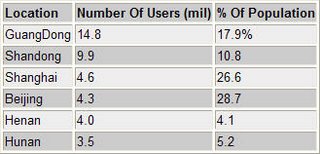
Chinese Internet users spend nearly two billion hours online each week, while the U.S. audience logs on for 129 million hours per week.
Source: China Internet Network Information Center, CNNIC.net
That's the bombshell Dr. Charles Zhang, chairman and CEO of Sohu.com (nasdaq: SOHU - news - people ), dropped last month after ringing the opening bell at the Nasdaq, a milestone for a Beijing-based company.
Zhang reported that, according to his internal research, Chinese Internet users numbered over 150 million--and possibly up to 200 million--and Sohu.com, including all of their properties, was in the top five most trafficked sites in the world. Nielsen NetRatings, which doesn't have statistics for China, reports that the U.S. had 154 million active users in January 2006. This means that China, if Zhang is correct, is at or above the U.S. in the number of Internet users and that these users stay connected far longer each time.
How could the milestone of China surpassing the U.S. in Internet users have gone so unremarked? It turns out that it isn't that easy collecting data on over a billion people in a country as vast as China, where most people are not connected by phone lines.
The China Internet Network Information Center (CNNIC) reports that the number of active Chinese Internet users was 111 million by Dec. 31, 2005, up from 94 million a year earlier. And over the past two years, it has been growing at a steady rate of 18%. However, according to Zhang, the CNNIC polling is conducted by calling fixed line phones. "Young people do not use fixed line phones. They all have mobile phones," Zhang said, explaining why he believes the CNNIC is reporting lower-than-accurate numbers.
Even if we assume that China is still behind the U.S. in terms of users, China definitely wins in another critical area. One of the most valued metrics of Internet usage (especially for advertisers) is time spent online. Chinese users average 15.9 hours per week, while Yahoo! (nasdaq: YHOO - news - people ), the most popular Internet site in the U.S., can only get its users to stick around for less than one hour per week (216.5 minutes per month according to ComScore Media Metrix). That's 1.765 billion hours per week online in China, compared with 129 million hours per week online in the U.S.
What's up with all that time online? This is the first time in Chinese history that the nation has been connected. As Zhang explains, "People log onto the Internet and Sohu.com because, in China, there is no Forbes, Reuters or The Washington Post. Print media was all state-controlled and official, and the Internet filled this void." Indeed, according to the CNNIC, 67.9% of online use in China is spent devouring news, more than searching (65.7%) and e-mailing (64.7%). By contrast, only 3% of Yahoo!'s U.S. traffic clicks over to news.*
Moreover, China has a lot more room to grow than the U.S. While roughly half of the U.S. population is actively using the Internet, just 11.7% of the Chinese population is currently plugged in.
Internet Users In China

Source: China Internet Network Information Center, CNNIC.net
There are 400 million cell phone users in China, with over 6.1 million mobile users connecting online.** As cell phones increasingly become the connection of choice, you can expect China, which is a generation ahead of the U.S. in mobile technology, to lead the world in mobile Internet-access growth. And everything will hit hyperdrive over the next two years, as the country ramps up to host the summer Olympics, which are being held in Beijing in 2008.
So why is Sohu.com the hottest site on the Web these days, when Baidu.com (nasdaq: BIDU - news - people ) is the better known brand in the U.S.? Sohu.com is up 40% this year, while Baidu.com, the blazing IPO of last summer, has lost 9% since January and is down 63% from its 52-week high.
While Sohu.com, Sina.com and Baidu.com are all in the top ten of most popular global Internet site--above Amazon.com (nasdaq: AMZN - news - people ) and AOL--Sohu.com has twice the revenue and three times the net profit of Baidu.com. And Sohu.com is the official Web site for the 2008 Beijing Olympics. Additionally, Sohu.com was the first publicly traded Chinese company, alongside Sina.com, to adopt Sarbanes-Oxley accounting standards, which speaks well of the management team of Zhang and CFO Carol Yu.
Sohu.com
Charles Zhang is not afraid of heights. Recently, Zhang, 39, the founder of Chinese Internet portal Sohu.com was clinging to the face of Mount Everest, 6,666 m above sea level. That's high but nothing compared with the altitude of his company's stock price. On July 10, Sohu shares closed at $38.25 on NASDAQ--a gain of 245% since April 1. More impressive, Sohu shares are worth 36 times their value during the dark days of the Internet bust, when they traded for less than $1.
Sohu, which started in 1996 as the first Chinese-language search engine, surprised critics by turning profitable in the third quarter of last year. For the second quarter of 2003, it posted a stunning $7.5 million profit on $19.3 million in revenue. But the climb has not always been smooth. During the shake-out following the dotcom crash, shareholders questioned the company's heavy dependence on banner-ad revenue. Hostile board members and disgruntled investors wanted professional management to replace him. Zhang says his nonconfrontational style helped him hold on, but the experience "was the worst sort of psychological torture." Short-messaging service, which helped the company turn around and generated total revenues of $750 million in China last year, now accounts for 48% of Sohu's revenues.
Zhang, who holds a Ph.D. in physics from M.I.T., sees parallels between his recent attempt to scale Everest and his near death business experience: "The temperature was subzero, with winds threatening to blow my tent over, and I was constantly out of breath. But as bad as it was, I'd sooner do it all again than repeat what I went through after the bubble burst." Is he out to climb more mountains? Undoubtedly; he's not afraid of heights. --By Kaiser Kuo/Chengdu
Subscribe to:
Posts (Atom)